Articles
Insex (Insect Reproduction)
By Karl Priest September 30, 2009
(revised
4-22-22 under “ Complications”)
NOTE: Much of this is copied or paraphrased from the original source.
SECTIONS: Attraction--Foreplay--Coitus--Sperm--Afterwards—Addendum--Complications-Evolutionism-Genitalia-and more
The categories may overlap, so search for a particular item of interest.
If any facts are repeated, please let me know.
I have not read (or even sneaked a peak at) Six-Legged Sex—the Erotic Lives of Bugs by James K. Wangberg. My sources are multiple articles from a variety of sources. I have paraphrased some items and pasted a copy in others. To keep it simple, I have not provided citations.
Evolutionists explain the evolution of sex with their usual “Alice in Wonderland” imaginations. In fact, one of their prominent just-so stories is called the “Red Queen Hypothesis”. (See “The Advantage of Sex” an adaptation of a New Scientist article at http://www.pbs.org/wgbh/evolution/sex/advantage/index.html.)
The evolutionist has no more basis on “why” sexual reproduction than I who believes that God designed it because He wanted His living creatures to “be fruitful, and multiply”.
This article will focus on the absolutely astounding methods of sexual reproduction used by just a few species of insects.
Why did such complicated means of reproducing and assuring survival of the species evolve? I’ll let the evolutionists make up those stories. I will keep it simple and proclaim that God displayed His omniscient originality, His colossal creativity, His grandiose genius, and His electrifying engineering ability.
In describing God’s creativity (Of course, evolutionists credit it to their god—evolution.) the articles I read almost always anthropomorphized insects and their mating and reproductive activities. Therefore, I am going to use human stages of sexual activity as sections about the phases of insect sex.
Before breaking the subject into categories, let’s consider a rare case of complete insect parenthood form “attraction” through “afterwards.”
Burying (carrion) beetles will search for a dead animal (such as a mouse or bird) and, if necessary fight other couples of it (male vs. male and female vs. female). If a single beetle locates a carcass it will await a partner. The mates will strip the fur or feathers to line the nest. The body is formed into a ball. After the larvae (babies) hatch, both parents will regurgitate liquid flesh to feed their young. The parents continue this until the larvae ae ready to pupate. During this time the adult beetles remove fungi and secrete an antibacterial substance onto the carcass.
Attraction
Male luna moths can detect the scent of a female from six miles away.
Male mosquitoes are drawn to the sound of the female's beating wing.
The female judges the m ale's desirability by his ability to beat his wings at the same frequency her.
The male fruit fly courts by chasing the female and singing with wing vibrations. The female will only respond if the song has a good “rhythm and tune”.
“The male (fruit fly)taps the female with his leg, which is studded with pheromone-sensing receptors. He then might doggedly follow her around and serenade her with a song by sticking out a wing and vibrating it. But before the male engages in this courtship ritual, he needs to make an important decision: Should he put the moves on this female or not? The males' internal state -- their libido or how amorous they feel -- and on external stimuli, such as the "quality" of their mating target… After that initial leg tap, the researchers explain, a flood of both excitatory -- "Go for it!" -- and inhibitory -- "Don't bother!" -- signals flow into the courtship command center, the P1. If the male's target is perceived as "low quality" -- not sexually mature, too young, too old, or if his pheromone receptors detect a low level of sexual desire in her -- the P1 center will receive more inhibitory signals than excitatory ones.” (https://www.sciencedaily.com/releases/2018/07/180713220147.htm)
“(M)ale cockroaches can ‘see’ fine structures of odor plumes, thanks to their finely tuned odor sensors on their antennae and neural circuits that convey spatial information to the brain.” ( https://www.sciencedaily.com/releases/2018/02/180208141228.htm)
Females from many different species of insect prefer larger body-sized males.
Stick insect males determine the correct species for a mate based upon the “perfume” (scent) of the female.
Fruit fly males are experts at choosing a mate that will produce the greatest amount of offspring.
Female horned beetles are attracted to males that spend time “courting” them rather than fighting other males. That includes large mandible fighting males.
Female fruit flies listen a long time (several minutes) to the male’s song before accepting him as a mate.
Female burying beetles attracted to small males because they are less likely to get into fights.
A beetle, known as tok-tokkie taps the soil with its abdomen to emit a drumming sound to attract a mate who answers in the same way.
Male horned flour-beetles with large mandibles have an advantage when fighting other males for female attention, but research shows that the females prefer male beetle courtship regardless of mandible size.
Some robber fly males wraps prey item in silk and presents it to the female.
Virgin hide beetles are attracted by a mixture of male sex pheromones and the odor of a dead body.
Older flies are lots less attractive than younger flies.
The smell of food acts as an aphrodisiac for fruit flies.
Some butterflies fly around looking for a mate. Others fiercely fight to defend a territory in order to watch the females that come by.
Female butterflies can smell if a male is inbred.
Male thornbugs send out “advertisement signals.” If he hears a signal from a receptive female the pair exchange signals in a “mating duet” until they make contact. They must filter out irrelevant noise.
(http://news.nationalgeographic.com/news/2004/08/0812_040812_thornbug_2.htm)
A grasshopper (Bullacris membracioides) rubs his leg on his abdomen to make an “intense mating call...considered tuneful only by members of the same species.... The Females respond with a softer, less-specific call, which enables males to locate them, and they perform duets together before mating.
(http://www.nature.com/news/1998/980827/full/news980827-2.html)
Females can be too attractive to the opposite sex –– too attractive for their own good –– say biologists at UC Santa Barbara. They found that, among fruit flies, too much male attention directed toward attractive females leads to smaller families and, ultimately, to a reduced rate of population-wide adaptive evolution... the term "good looking," among fruit flies, refers to something, like a large body. From the perspective of a male fly, a desirable mate is a female that is larger and can therefore produce more offspring. (http://www.eurekalert.org/pub_releases/2009-12/uoc--uss120709.php)
The well known cricket chirp is the male calling for a female. When she gets close enough he softens the chirping.
Mole crickets construct megaphone shaped tunnels from which to call for a mate.
Cicada males sing by the thousands, often mixed with two other species—yet the female can distinguish the song of her species.
Mosquitoes synchronize the pitch of their buzzing (from wing beats of 600 times per second). If the tones match, they know they are of the same species.
Male roaches whistle (described as bird-like) for females. The complicated sound is produced by pushing air through abdominal holes and actually is two different tunes.
Water strider males produce a courtship song by tapping on the surface of the water.
Many insects use perfume (pheromones) to attract mates. A female of a scarab beetle species releases this chemical to entice males to come to her. The male beetle smells with his antennae where special switches send nerve signals to his brain as the pheromone molecules arrive. As he flies toward the female he must continually reset his scent detection system in order to adjust to various levels of the scent.
Male bumble bees mark leaves with their scent then patrol the area until a female arrives.
A type of butterfly has males that have brush like organs that he can spread out from the end of his abdomen. The purpose of the brushes is to spread a special scent. He obtains the scent from a particular plant and without it he could not get a female interested in him.
Different species of butterflies use individual methods to disperse pheromones to the female. One stands next to the female clapping his wings catching her antenna. A second gets in front, leans forward, and slowly rubs her antenna between his wings. A third gets on the female’s side and drags his forewing over her antenna as he waves his forewing. This usually takes about 30 seconds.
The African satyrid butterfly is attracted to the bright light produced by ultraviolent reflection from the center of the male’s wing eyespots.
Female fireflies flash in response to the male flash. The females are attracted to males with the longest flash. (Each species has a unique code.)
Some male fruit flies have courtship songs that are complex rhythms. Others perform a dance showing off their wing spots.
Dance fly males bring a fresh killed insect to swarms of females. Some wrap it in silk they spin from their legs. This allows longer time for copulation.
Stalk-eyed female flies are attracted to males with a wider separation of eyes. The most prominent male can mate with 24 partners in 30 minutes.
Tiger moth females release a pheromone to attract a male. He clicks when he senses it and she clicks in response. The clicks continue until they locate each other.
Female silkworm can determine the ancestry and age of a male by the male’s smell. They only have a few days to locate a mate.
Stink bugs vibrate their bodies to send information across a plant about their location, sex, and receptiveness.
Some male insects must provide the females a nutritious gift
(spermatophylax)
to entice her to mate. The bigger (can be 30% of males body weight) the gift, the longer she allows his sperm to enter her body. The males of a fruit fly species have one over 20 times the length his body. He provides about 5 sperm each time he mates. His testes can reach 11% of his body weight.
The song of a male cricket to attract a mate can also attract a parasitoid fly which leads to his slow death.
The crucial use of pheromones by insects has been targeted by scientists to design methods of controlling those insects who are pests. A prime example of that is using the attractant scents to lure the insects into traps.
A type of Bush-cricket beats on a leaf its hind foot to attract a mate.
Using specialized wings “male damselflies perform elaborate courtship displays, attracting females with high-speed flying manoeuvres.” The ones that “warm their bodies by flying in the sun are indeed 'hot stuff' and attract more females.” The assumption is that “hot-bodied males may benefit females by having access to the warmest territories, which in turn are optimal sites to lay eggs” and “mating with a male in a sunny patch may also allow a female to stay warm while laying her eggs in the cold water. That will increase her ability to escape from predators and other male damselflies. Hotter males may also be better at defending their mates.”
Scientists played a recording of the “song” made by male wing vibration and then studied the flies’ active genes. The ones in the females’ antennae indicated “excitement”. It takes 2,000 brain cells for that to occur. Experimenters were surprised “that genes involved in immune function were also switched on.”
A male mole cricket will dig, test, and adjust dimensions of a burrow used to amplify his calling for a female.
Some beetles send out aggregation pheromones (scent) that attracts both sexes to a central area.
Mayfly mating swarms can be so large that they stop traffic.
Some fly males “sing” to attract females by producing wing beat frequency.
Butterflies and moths advertise attractiveness by their coloration.
Male long-legged flies flash a white wing spot to attract a mate.
Female chafer beetles send out a scent (pheromone) that attracts males from a long way off.
A female dragonfly will play dead to avoid unwanted suitors.
Foreplay
If a female robber fly is not satisfied with her potential mate, she will go limp after he grasps her. This removes stimuli and he leaves.
Dragon mantis females inflate a green shiny Y-shaped gland that emit a pheromone scent that males are very highly attracted to.
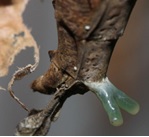
Male butterflies that have the ability to plug the genitalia of the female do not do a courting ritual. Instead they chase the female, grab them in flight, and pull them to the ground.
The Forked Fungus Beetle males use grip strength to hold on to the female and shield her from other males in an elaborate courtship ritual.
Although sometimes not classified as insects springtails bang heads during foreplay. The larger female, using his specially designed antennae, lifts him into the air supposedly to gauge his weight.
Sometimes a red flour beetle female practically forces a male to mate with her.
Many species of butterfly males drench the female with an aphrodisiac scent.
A pair of dung beetles rolls a ball of dung to serve as a nursery for their offspring.
Some male springtails caress each other with their antennae before mating.
The silkmoth male has special dance that he does after detecting sex pheromones from the female. He walks toward her, sometimes straight and other times in a zigzag making several turns before making a 360 degree loop turn.
A type of male beetle stores a chemical substance in a gland in his head. Before allowing coitus the female uses her mandibles to make sure he has the chemical. No chemical—no coitus.
Some wasp species males use a complex coiling of their antennae around the female antennae allowing the male glans to precisely contact the female receptors.
A species of fruit flies has a male that follows the female softly tapping her with his leg. Later he extends a wing and vibrates it. Finally he uses his proboscis to stroke the female’s genitalia. The courting ritual is a complex sequence of specific steps. Another fruit sly species’ male dances by sliding and circling with complex footwork and vibrating his abdominal muscles to produce a purring serenade. He can continue for an hour and the female will hit him if he stops. These tiny flies are able to do these complicated tasks soon after being born.
The tsetse fly has a lengthy detailed 30-minute foreplay process where the male rubs the female’s underside with his hind legs, sings with his wings, strokes her eyes with his front legs.
Male tree crickets raise their wings in order to sing. This exposes a body cavity known as the “ honey pot.” Female tree crickets sip secretions from this gland which puts the female in to a perfect position for mating.
I have personally observed the mating of crickets and mantids. Both were kept as “pets” in my home. I was awed at what I observed and there were things going on beyond my powers of perception. The mantis female did not eat her mate. There is some information about mantid mating in Ready to Prey.
Male fruit flies approach the female, gets close to her face, and sticks out his tongue. Then they dance.
Coolie butterfly males drench the female with an aphrodisiac scent.
Beetles use a complex stroking ritual with his antennae. Others produce a chemical for the female to chew and others taste the female by nibbling on her wing covering.
To hasten copulation a male water strider will strum the water to attract predators which threaten the female.
Coitus
Paper wasp males attempt to mount females while stroking her abdomen. As the copulate the male will also push out his genitals and stroke the female’s antennae. Females try to get away.
Trilobite beetle females resemble the extinct trilobites that True Believers in Evolutionism write much about. The males look entirely different from the female and are much smaller (5mm compared to 6 cm). As the female grows she will “curl up under a piece of wood and remain there, unmoving, for two to three days as they shed their old exoskeleton and develop a new one. After they’ve gone through a series of moults, the females will once again look fat, but this time it's not their insides outgrowing their outsides - their abdomens will be swollen with a mass of unfertilised eggs. The newly mature females will then emerge from their shelters and begin a kind of courting display that involves raising their abdomens into the air to expose their gonopores - a genital pore found on the underside of many types of insects…They’ll display like this for four to five days…” During the observative of mating, the “male had attached himself tightly to the female's gonopore using his long, curved genitalia, and held onto her like this for about five hours. About three hours after detaching himself, the male dropped dead. The next day, the female laid a sticky mass of around two hundred eggs in a humid patch of leaf litter before dropping dead herself a couple of weeks later.”
https://blogs.scientificamerican.com/running-ponies/trilobite-beetles-are-happy-being-on-land-alive-in-the-present-day/
“Some male butterflies go to extreme lengths to ensure their paternity -- sealing their mate's genitalia with a waxy "chastity belt" (pre-molded plug “which hardens on the female's abdomen”.) to prevent future liaisons. But female butterflies can fight back by (growing) larger or more complex organs that are tougher to plug. Males, in turn, counterattack by fastening on even more fantastic structures with winglike projections, slippery scales or pointy hooks.”
https://www.sciencedaily.com/releases/2020/09/200903155503.htm
To attract females, male cockroaches secrete a sweet substance from a gland in their abdomen by lifting his wing covers and turning his rear toward the female. If she thinks his secretions taste good she will sit on his back and they copulate for about an hour and a half. The males uses a hook on his penis to make sure she stays put. His sperm is transferred in a package (spermatophore) which also contains nutrients for the her and the eggs.
Male diving beetles use suction cups on their feet to hold on to females.
The native twisted-winged parasite females live in mining bees with only a small part of their abdomen visible. The male twisted-wings only live a few hours. In order to impregnate the female must push his hook-shaped penis into the female’s neck area.
Male honeybee genitals explode after intercourse. The ejaculation is so powerful that it ruptures the endophallus (internally held penis) , disconnecting the drone from the queen. The bulb of the endophallus is broken off inside of the queen during mating—so drones only mate once, and die shortly after. The leftover penis remaining in the queen’s vagina is referred to as the “mating sign”. The plug will not prevent the next drone from mating with the same queen, but may prevent semen from flowing out of the vagina.
A male dragonfly has to transfer some sperm from on his abdomen to his penis.
A male dragonfly can destroy the sperm of his competitors. Some dragonflies have backwards-facing hooks or barbs on their penises, which they can use to scoop out any sperm they find inside their partner before depositing their own. Other dragonflies use their penises to tamp down or move the offending sperm, pushing it aside before he places his own in the ideal location for fertilization. Other dragonfly males will dilute any existing sperm they find.
A springtail male deposits sperm on a surface and then gently coaxes the female his partner to take it. He may nudge her toward his spermatophore, offer her a dance, or even impede her path away from his sperm offering.
Silverfish males attach their spermatophores to threads, and sometimes bind their female partners to force them to accept their sperm gifts.
Scorpion fly males offer hardened saliva or a dead insect for their mates to indulge on during intercourse. He also possesses the ability to use a clamp, located behind his wings, to force the female into a mating position.
Sagebrush cricket females eat part of the male’s hind wings why copulating.
During copulation the female passionflower butterfly sticks two stink clubs (located on her abdomen) into a pouch on the male to obtain a putrid smelling pheromone that keeps other males away.
In order to allow the male access to her genitals some female butterflies must move their abdomen out from between their wings.
Midges mate in flight.
Water strider males have grasping hooks to hold the female and the females have spines to release the male when she is ready.
Zeus bug males use a special saddle on the female’s back where he rides, eats (food provided by his mate), and mates for several days.
The female cricket climbs on to the male’s back.
Some insects mate facing away from each other.
Male bedbugs stab the female’s exoskeleton to inject the sperm.
The sperm then has to swim through the blood system to find the ovaries and fertilize the eggs.
Dragonflies use the wheel position—which resembles a heart shape.
Some wasps mate inflight with the female attached to the male genitalia.
Some insect males insert free sperm and others insert a sperm package for storage by the female.
Apollos butterfly males insert a plug into the female genitalia to prevent other males from mating with her.
A male muscid fly tackles the female in slight and they tumble to the ground, finished in a few seconds.
Scaly crickets can copulate 50 times per day for up to six days.
Some species of female water striders have a hard shield over their genetalia that must be opened before mating.
Monarch butterfly males hold down their mate all day long.
Virgin honeybee queens mate with drones in or near drone congregation areas. They copulate in flight. Mating lasts less than 5 seconds (usually 1-2 seconds). Samples of the variety of copulation duration:
Midges: A few seconds
Fruit flies: 20 minutes.
Some flies: 1-2 minutes
Antler flies: 2.5 hours
Ornate moths: 9 hours
Lovebugs 56 hours
Zeus bug: 1 week
Sperm
Male honeybees insert substances while having sex that causes temporary blindness in the female. That prevents the female from mating with other males.
Male honeybee seminal fluid has toxins to kill the sperm of rivals.
The sperm of ants can comprehend that there are rival sperm and move faster and straighter as a result.
Various insect males can make a capsule (spermatophore ) encasing his sperm. It contains other ingredients (like protein) that the female needs. Some butterfly and moth species contribute 10% of their body mass in making the capsule.
The capsule can be given to the female during copulation. Some silverfish put silk threads around the packet as a signal to the female. Some springtails leave the packet on a stalk on the ground for the female to find. Other silverfish and bristletail males guide the female to the capsule.
Some females have spines in their genital tracts that puncture the capsule to release the sperm. Then the packet is digested to aid in egg production.
Some scale insects can make a female egg by opening the valve at the base in an organ where she stores sperm and release sperm onto the egg as it passes through the tube leading from the ovary to the outside. To make a male egg she keeps the valve closed.
Cabbage butterfly males have a highly complex concoction of ejaculate that delivers sperm and life-extending nutrients. It contains 13% of the entire male’s body weight. The females have chewing apparatus in their reproductive tracts which is designed to devour the package. It takes her three days to do it.
Female insect eggs have small openings in the outer surface which provide a way for the sperm to get inside.
The sperm of some diving beetles will join together in groups of up to thousands in a worm-like shape. Other species have sperm that are able to glue their heads together.
A female fruit fly may mate with more than one male. Usually the last mating produces the most offspring except right before hibernating for the winter. Then only the first mating male is the father.
Honeybee queens mate with a many males (drones) to fertilize her eggs randomly with their sperm.
A species of harvester ant queens can control the use of sperm to produce either sterile workers or fertile queens.
Mosquito sperm have a “sense of smell” and some of the things smelled cause the sperm to swim more vigorously.
In honey bees the sperm remains viable for the queen's entire life. Special secretory cells keep the sperm healthy. When an egg moves into the oviduct, a contraction of the spermatheca pushes sperm through a duct to where it meets the egg.
After receiving sperm a female fruit fly’s reproductive tract produces secretions to activate, guide, and store it.
The sperm of male fruit flies are coated with a chemical 'sex peptide' which inhibits the female's usual afternoon siesta and compels her into an intense period of foraging activity..."It would appear that preventing sleep and inducing extra domestic-type duties to prepare for the birth of offspring in females is a further tactic used by the male to ensure successful paternity after mating. (http://www.eurekalert.org/pub_releases/2009-09/uol-ffs092709.php)
“Insect ejaculates are a soup of proteins and peptides that are immensely complex”. Dr. Goran Arnqvist (Uppsala University) That statement is typical of many that I read from scientists who study any aspect of insect reproduction.
Many males attach a sperm packet which slowly pumps sperm into the female.
A type of mothreleases pheromones as a sample when he is “courting” a female. Then he pumps this chemical from his sex organ in his seminal fluid. This provides the eggs with a foul taste to predators.
Firefly males provide a nutritional substance (spermatophore) that the female use to nourish their eggs. She mates with many males and is able to control the amount of eggs each male fertilizes. Scientists think that insects having sex with multiple mates is a check against inbreeding.
Male fruit flies place a pheromone on the exterior of the female that keeps other males away from her. Some species have males that produce sperm that is 300 times longer than that made by humans. Female fruit flies seem to know if they have an adequate amount of sperm stored in their specialized organs.
Some beetle females have a specially designed tooth to pop the packet of sperm in their bodies.
Monarch butterfly males can select the amount of fertile sperm they ejaculate. Since monarchs do not use pheromones, scientists speculate the penis contains sensors to detect the amount of sperm already in the female.
A male flour beetle that loses battles with other males over mating rights will produce double the amount of sperm which increases his changes of successful reproduction since his chances are limited.
In many insects sperm from different males compete the female’s reproductive system.
The sperm cells of fruit flies are longer than the body of the fly.
A diving beetle produces sperm that form trains of two to hundreds or thousands of individuals.
A leafcutter queen will collect 300 million sperm before setting up her colony.
Female water striders can store sperm for weeks.
Afterwards
A species of fruit fly prefers to lay her eggs in fruit that has never been touched by other flies (male and female).
Honeybee sexual activity occurs during a brief period early in a honeybee's life. Afterwards the males die and queens can live for many years and not mate again.
Some insects have very tiny specialized structures, known as egg busters, they use to get out of the egg.
Some insects protect their eggs by laying them in communal groups or by using toxins to fortify them. Fruit fly mothers place a sex pheromone in the thin wax egg layer that acts as a scent mask for other fruit flies and as a leak protection to prevent desiccation.
The native twisted-winged parasite babies hatch and devour the insides of the mother.
Lord Howe Island walking sticks pairs sleep together with three legs of the male over the female.
Burying beetles pair up, find the carcass of a dead animal, and use it to raise their brood.
A male and female dung beetle will bury a ball of dung on which they mate and some species stay on it to raise their brood.
There is evidence they stay together for life.
To protect against UV radiation stink bug females can vary the darkness of their eggs according to the amount of light reflected off a leaf surface.
The (fruit) fly's eggs are normally made in the ovaries and move down a long, narrow tract into the uterus, where they are fertilized by sperm that are already stored there. After fertilization, the fly lays her eggs: where and when depends on how good the environment is for the offspring. They have a set of motor neurons that squeeze the reproductive tract to push out eggs when the time is right.
Some fig wasps males work together help a pregnant female survive.
Male fruit flies that are able to mate live longer.
Having sex effects immunity, libido, eating and sleep patterns in female fruit flies.
A pregnant tiny parasitic wasp must get onto a pregnant butterfly in order to lay her eggs on those of the butterfly.
Male dragonflies will often guard the female until she oviposits her eggs. He also tries to stop her from mating with any other males.
To keep other males from copulating with his “bride’ some male butterflies plug the genital opening of the female after he inseminates her.
One insect male leaves a pheromone which is the chemical equivalent of the "letterman jacket." After mating it rains on the female’s outer body to ward off other suitors.
A female field crickets can influence the father of their offspring, even after mating with up to ten males. They may be using abdominal muscles to control the amount of sperm stored from each mate. Offspring produced with close relatives are more likely to have genetic disorders.
The purpose of sexual intercourse for insects is reproduction. Although some insects give live birth, most lay eggs. The design of insect eggs (not to mention the stunning beauty of some) is astounding.
Where the eggs are deposited and camouflaged can be fascinating. Just a few examples: Mantids produce a Styrofoam like covering around their eggs. Lacewings deposit an eff on top of a stem raised vertically. Moths can cover eggs with stinging hairs. There are more fabulous facts about egg laying and eggs, but that is for another entire article.
Most female insects deposit their eggs and never give them another thought (figuratively speaking).
The newly hatched insects are quite capable of surviving and that is part of God’s design for continuing insect life. Insects do not have a capacity to think and love, but some have been designed to extend the care of their progeny.
Female damselflies will mate with more than one male then sort through the sperm and choose the best.
If food is low the babies may be eaten by the insect mother.
A wasp species will produce more females if there is ample food. (That is design. If there is plenty of food the daughters will not need many brothers to mate with.)
There is a female wasp that injects just enough venom into a roach’s brain so that she can steer it zombie like to the nest to serve as food for her brood. Other wasp species provide drag or carry paralyzed spiders or caterpillars and store them for use by the babies after they hatch. The mother is long gone by then.
Some water bug females lay eggs on the male’s back where fertilization occurs. The female leaves. After the eggs hatch the male will sometimes care for the babies a little while.
Some stink, lace, and assassin bug mothers protect their eggs even through one molt of the babies. So do tortoise beetles and at least one species of mantid. Earwigs even feed 50-100 babies
and the babies share food with their siblings when the mother is away. Believe it or not, some roach species care for their young.
There are cockroaches that stay together after they mate with both sexes caring for the offspring. The female feeds the babies with a milk like excretion.
Many insects can store sperm from one or more males and self-fertilize for as long as years.
Termites keep life-long mates. This article cannot get deeply into the sexual activities of these and the other social insects: ants, bees, and wasps. Just see a tiny bit about those insects in “Complications” below.
In just a few days, a single army ant queen can lay up to 300,000 eggs.
To prevent their sperm from being displaced, many species have males that watch the female until eggs are laid.
Some females secrete an odor that deters other females from laying eggs nearby. Some beetle males help with burrowing and guarding the nest.
Some female mayflies can law 3000 eggs.
Where and how the eggs are laid is mind-boggling. For example, female butterflies test leaves with receptors on their feet, antennae, or abdominal tip in order to decide if it is a suitable egg site. She will calculate the humidity, temperature, and plant location relative to protection and presence of other eggs.
Female insects deposit eggs in a number of ways: on the ground, buried in the ground, in water, on the plant the baby eat, inside other insects, on dead animals, on stalks, glued to the male’s back. Insect eggs come in an awesome variety of coloration and arrangement. Just Google images of “insect eggs” and be awed! Some produce egg case containers (ootheca) where many eggs are deposited. The mantid ootheca looks like a dirty chunk of dirty Styrofoam. Roach ootheca (not all roaches produce oothecae) resemble shiny brownish oblong purses. Some roaches drop the egg case in a safe place. Others carry it around attached to the end of the abdomen.
----------------------
I admire and thank the scientists who have unlocked a few of God’s mysteries. It is pathetic that many of those scientists do not give God the credit for His designs. All of the research and media reports would have been just as informative and amusing had the evolutionist idiocy been omitted.
This article has barely skimmed the surface of the immense volumes of facts about insect sex.
ADDENDUM
Complications
A
type of scale insect was thought to have nearly all hermaphrodites (one individual produces eggs and sperm) and a tiny amount of males—no females occur. In 2011 scientists found out that the cottony cushion scale actually is fertilized from parasitic tissue received at birth and which contains sperm left from the insect’s father. So this intriguing insect can be a grandpa and daddy to his “child”. Science writers made much ado about this being incest
and the elimination of males.
Nevertheless, normalcy is the norm because if
the father’s sperm does not work, the eggs become male and normal mating is possible.
Some insects reproduce parthenogenically. Parthenogenesis is a form of asexual reproduction where the egg develops without fertilization. That, in itself, is amazing and evolutionists really have to tell some “Just So” stories to explain it, but it gets complicated by much variety in how it occurs. Sometimes there is no mating. Other times there is mating, but only female chromosomes are activated. Then there is egg meiosis and eggs without meiosis.
Most insects have the male XY (heterogametic) and female XX (homogametic) chromosomes, however some species have no Y and males have a single X. In butterflies and caddis flies that is reversed and males are homogametic while females are heterogametic.
To further boggle the brain, some bees, ants, wasps, beetles, scale insects, and thrips, determine the sex of individuals by a process known as haplodiploidy. The eggs can develop even without fertilization. A female that has not mated can lay eggs that become males. A mated female can CHOOSE to lay female eggs by releasing sperm as the egg is laid or she can lay male eggs by containing the sperm in a storage sac. So males have a mother, but no father and cannot have sons but can have grandsons!
Worthy of the “BWAH HAH HAH HAAAA!” article is how true believers in evolutionism try to explain their belief that
“‘Stick insects have lived for one million years without sex’… Certain species of Timema stick insects were known to reproduce asexually, with females producing young in "virgin births" without the need for egg fertilisation by males. The insects instead produce genetic clones of themselves.” They have to explain that continuous cloning of genes devolves the species because the insects are less resistant to disease and reduced adaptability. Despite the article headline (between the ‘’) the bottom line is the unanswered questioned at the conclusion: “"Why Timema asexuals have been able to persist for so long despite all the predicted negative consequences of asexuality is the focus of ongoing studies."
Related to this subject is a discovery that t he ant species (Mycocepurus smithii ) queen is physically unable to mate. Part of her reproductive system known has degenerated. (That is devolution!--Karl) "Asexual reproduction of males from unfertilised eggs is a normal part of some insect reproduction, but asexual reproduction of females is "exceedingly rare in ants." Another article reported that most populations of the ant Mycocepurus smithii are asexual, but not all and “the transition among reproductive modes happens repeatedly.”
Evolutionists claim the advantage to a sexless life is that "It avoids the energetic cost of producing males, and doubles the number of reproductive females produced each generation from 50% to 100% of the offspring." However, combining genetic material with sexual reproduction is a much better way to reproduce because diversity means better resistance to parasites and disease.
Evolutionism
An evolutionary arms race between female and male water bugs leads to strange spikes, hooks and pads on the lad's antennae…These unusual extras accessories allow the male water striders to grasp resistant females during sex…Female water striders are able to store up sperm for later fertilization, so it benefits them to only mate once. Males, on the other hand, want to fertilize as many females as possible. So to overcome potential mates' resistance, many male water striders in the genus Rheumatobates have developed specialized appendages to give them an edge in this battle…with at least four antenna structures: one with a wrenchlike shape formed by the antenna segments; a spike that fits into the groove between the female's head, thorax and eye; a pad that rests under the female's eye; and a hook that can fit either between the head and thorax or between the female's thoracic segments. (http://www.livescience.com/20079-water-striders-sex-evolution.html) Calling it an “evolutionary arms race” is silly! Where is the evidence that the intricate spikes, hooks, and pads developed over time? One might as well believe a lock and its key evolved without being designed by an intelligent being.
Red flour beetle females mate multiple times a day including several times an hour. Although, there didn't seem to be any evolutionary benefit to it (Female promiscuity). Scientists examining red flour beetles suggest females have an innate drive to sample lots of sperm to find the most compatible seed and increase the number of offspring that will survive. Which makes sense. Scientists at the University of East Anglia in the United Kingdom found that inbred female red flour beetles mating with just one male had a 50 per cent fewer surviving offspring than non-inbred beetles. Those mated with five males managed to have the same reproductive success as non-inbred populations. ( http://fooyoh.com/geekapolis_gadgets_wishlist/6559379) This scientific fact about that beetle will be used to preach evolutionism and promote human promiscuity. (Also see the entry about bushcrickets under Genitalia above.)
Female diving beetles have complex reproductive tracts. A scientist said, “Sperm needs Swiss army knives and compasses to make it through.” Evolutionists say, "The females make it really complicated." They claim the male sperm evolves to be able to navigate the female tract as it changes. Reality proclaims, “It is sperm. They are reproductive tracts. They are diving beetles. Those facts will not change. The knowledge that the sperm and female reproductive tracts are designed with the capacity to change is nothing more than an interesting observation of the Creator’s design.
A beetle species has females with genitalia containing a moveable plate with grooves and pits for anchor points. The male genitals have projections that fit the female’s grooves and pits. Scientists observed that the genitals change “ faster than previously expected” creating new species that are unable to mate without matching parts. Worthy of “BWAH HAH HAH HAAAA!” evolutionists say, “Female and male organs that fit together like puzzle pieces evolved into new shapes simultaneously.”
As of November 2013 there were less than three dozen examples of prehistoric insects engaging in sexual intercourse. Most of them were preserved in amber. The latest was two froghoppers found in the Jurassic rock. The specimens (a new species, but identical to living froghoppers) were preserved belly-to-belly. But living froghoppers mate side-by-side. The speculation is that the fossilization process (we know it to be likely due a catastrophic flood as in Noah) caused the difference. Of special interest is that “the genitals of these ancient insects are strikingly similar to those of their modern counterparts.” (http://phenomena.nationalgeographic.com/2013/11/06/jurassic-sex-set-in-stone/)
In an article headlined “ Why nice guys usually get the girls” we find that a primary premise of Darwinism is disputable because previous studies had confined female water striders in a way that was not natural to the way they really lived. This new study found that “Groups of low-key male water striders mated with more females than did groups of highly sexually aggressive males.” Instead of simply saying that Darwin was wrong, the author hedged his words by saying, "The naive view of Darwinian evolution is that it always favors the most savage, brutal and selfish behaviors. It doesn't -- and this is one example of that.” (http://www.eurekalert.org/pub_releases/2009-11/uoa-wng110409.php)
Genitalia
"A detailed study of the penetration structure of a cassidine beetle (subfamily of the leaf beetle: Sometimes these elongated structures are extraordinarily long, a couple of times the body size. However, irrespective of the length of these structures, the animals can precisely control their movement to fulfill their original functions. Insertion and/or excavation of these hyper-elongated structures in nature are mechanically challenging… In insects, the entire intromittent organ ( An intromittent organ is a general term for an external organ of a male organism that is specialized to deliver sperm during copulation. WikiPedia) is usually stored in the abdomen. Therefore, males have to move the elongated structure for rather long distances to insert the elongated structure from their abdomen into a female duct, which is usually called spermatheca (or spermathecal duct). Although a tunnel-like structure, into which the elongated structure penetrates, is situated in the female, the correspondingly long female structures are convoluted and/or highly coiled and penetration does not appear to be a very simple task for male”
(http://advances.sciencemag.org/content/3/12/eaao5469.full) SEE THIS DETAILED IMAGE.
Crusader bugs use their hind legs to fight for females. If he loses a leg he grows larger testes.
The thistle tortoise beetle’s penis is longer than its entire body and is able to follow the female’s coiled sexual organ.
The (honeybee) drone penis is designed to disperse a large quantity of seminal fluid and spermatozoa with great speed and force.
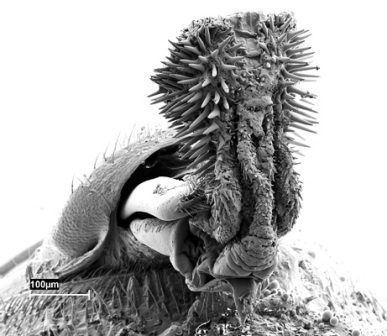
The (seed beetle—see image below) males' sexual organs have barbs and spikes that resemble medieval torture instruments... "They literally injure females internally in their copulatory duct... The new research offers the first proof that dangerous genitalia in males can represent a reproductive advantage. The resulting wounds in the females, however, are likely just an "unfortunate side effect" of the strategy, Arnqvist said, and do not provide a reproductive benefit... he suggests longer spines may act as an anchor: "Males can position their genitalia in an optimal way inside the female as the male releases [its] sperm."... it makes a "convincing case" that sperm success is due to the spininess of the genitalia, not to the damage to females... Females have thick padding on their reproductive tract that's reinforced with strong, elastic connective tissue. After each mating event—about five to ten in their 25- to 30-day lifetime—the wounds heal and leave scar tissue. (http://news.nationalgeographic.com/news/2009/02/090225-seed-beetle-sex.html)
Almost all insects have their genitalia inside their bodies.
Taxonomists rely on male genitalia to distinguish between many species of insects.
The cockroach reproductive apparatus was described as looking like a Swiss army knife. Referring to male reproductive organs William G. Eberhard (Smithsonian Tropical Research Institute) said, “It is just too fantastic to believe that such complicated machinery is necessary only to perform a mechanically simple function.”
Earwigs have two sets of functioning genitals.
Dragonfly genitalia consist of parts that resemble brushes, pipe-cleaners, and beach balls and can scoop out sperm deposited by other males.
The male European rabbit flea has the “most complicated genitals in the world. These are adorned with springs, levers, hooks, barbs and all sorts of twiddly bits. Here is a precision instrument that seems better suited to telling the time than depositing sperm.” (http://www.newscientist.com/article/mg16121768.400-secret-weapons.html)
Male damsel flies have a penis designed with a sort of scoop on their penis to remove the sperm from a previous male.
The mayfly male has two penis-like organs and the female has two sexual openings and both (of each) are used simultaneously.
Insect female genitalia are difficult to study so more complicated designs are yet to be discovered.
For at least one species of cricket, the tuberous bushcricket (Platycleis affinis), the testicles take up 14 percent of the insect’s body mass! To put this into perspective, a man with the same proportions would have to carry testicles weighing as much as five bags of sugar each. “We couldn’t believe the size of these organs, they seemed to fill the entire abdomen. “It looks as though the testes may be that big simply to allow males to mate repeatedly without their sperm reserves being exhausted.” ( http://blogs.discovermagazine.com/discoblog/2010/11/10/and-the-prize-for-worlds-largest-testicles-goes-to%e2%80%a6-the-bushcricket/#more-13915)
The researchers discovered that each female bushcricket takes many mates, up to 23 in a two-month adult life. It seems this lifestyle has driven the males’ evolution of mega-testicles, giving them the stamina to keep up with these promiscuous ladies. (http://blogs.discovermagazine.com/discoblog/2010/11/10/and-the-prize-for-worlds-largest-testicles-goes-to%e2%80%a6-the-bushcricket/#more-13915) Har, har, har! Both sexes could have been designed pretty much the way they are now. (Also see the entry about red flour beetles under Misc below.)—Karl
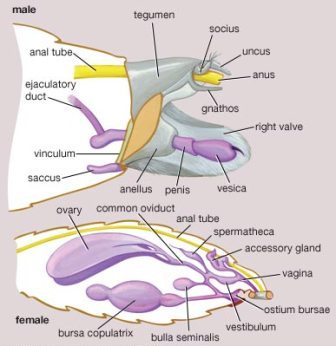
Simplified diagrams of Lepidoptera (moths and butterflies) genitalia:
http://www.britannica.com
Seed beetle male genitalia:
http://news.nationalgeographic.com/news/2009/02/photogalleries/spiky-beetle-genitals/photo3.html
History
Insects have been sexual since as far back as the fertile imaginations of evolutionists can conceive. There are Jurassic fossils of dragonflies engaging in sexual intercourse just as they do today. Two mating midges are in amber (40 million years old if you are a true believer in evolutionism) copulating as if they were captured yesterday.
Homosexuality
Research on a tiny flour beetle included the obvious statement, “From an evolutionary perspective, why homosexuality exists at all is a mystery.” There was no benefit to sexual success (offspring) with females and the mixed up male beetles gained no added female attention. Then the True Believers in Evolutionism (TBEs) were ecstatic to discover that semen spilled by male beetle A on beetle male B may impregnate a female when B attempts to mate with her. The TBE’s proclaimed that “homosexual behavior yields a direct reproductive benefit, allowing males to inseminate females without expending time or energy having sex with them.” They missed the effort of A to mate with B which was a hopeless attempt to spread A’s genes. Also, they neglected to mention that beetle B was penalized with no offspring for that attempt. (http://news.nationalgeographic.com/news/2008/11/081104-homosexual-beetles.html )
Some species of insects that exhibit homosexual behavior also mate with inanimate objects, like beer bottles. There is male resistance to homosexual behavior. (http://www.sciencedaily.com/releases/2013/10/131021131009.htm) Any aberration is devolution with confusion caused by them not perceiving the scents and sights they should.
A somewhat related, agenda driven ambiguously worded, 2014 article (http://www.sciencedaily.com/releases/2014/04/140417101146.htm ) claimed that a genus of cave insects have “sex-reversed genitalia”. The female inserts a “penis-like organ” into the male’s “vagina-like opening”. That is unique except the “penis-like organ” receives sperm and it is the male fertilizing the female as always. Pointing to a complicated design is that while the female part is inserted it inflates and multiple spines that lock it inside the male. It is merely an extended vagina. The male penis widely varies including a condition known as a “concealed penis” (http://www.drgreene.com/articles/inconspicuous-penis/). Another “BWAH HAH HAH HAAAA!” worthy statement is that scientists want to study these insects to find out about “the evolution of novelty”!
Probably alluding to transvestism, a claim is made that a rare butterfly is half male and half female. The Lexias pardalis has male colored wings on its left side and female colored wings on the right. The condition is caused by a genetic mistake in the embryo. So, first of all, it is a MISTAKE. Additionally, the mistake sometimes causes a mosaic coloration which is not even noticeable. Finally, some species males and females look alike anyway! It is an interesting genetic issue, but does not provide support for any human perversions.
The bottom line: “Same sex mating behaviour amongst male insects is much more likely to be due to incompetence, than sexual preference…” (https://www.sciencedaily.com/releases/2018/05/180510101247.htm)
Male Competition
Often insect males will protect territories and/or fight over females. A couple of examples are: 1. Tanzanian roaches that have serious wrestling matches. 2. Male dragonflies will ferociously defend territory from other males.
Often male insects who are around other males are more successful in mating.
Some fig wasp males help other males attract females, succeed in mating, and then help the female continue her pregnancy.
Scorpion fly males sometimes try to steal a “nuptial” gift held by other males.
Stalk-eyed flies compete with each other by comparing the space between their eyes. Wider spaces are dominant.
STDs
Sexually transmitted diseases (STDs) of insects are known from the mites, nematodes, fungi, protists and viruses. In total 73 species of parasite and pathogen from approximately 182 species of host has been reported...
STDs of insects are often highly pathogenic, and are frequently responsible for sterilizing their hosts, a feature which is also found in mammalian STDs. (http://journals.cambridge.org/action/displayAbstract?fromPage=online&aid=241109)
Bed bugs protect their sperm against sexually transmitted infections by producing germ-busting ejaculates, scientists have found. Female bed bugs protect themselves against the diseases that males transmit with a structure on their bellies that guides the penis into a mass of germ-fighting cells. (http://www.bbc.co.uk/news/science-environment-14716106) Scientists are studying this phenomenon to possibly help prevent human STDs.
Researchers have discovered that, for a female fly, preparation for mating involves the "rather unromantic" anticipation of potential infection…"It appears that if she hears a sexy song, she knows she's likely to mate soon, so she makes the physiological change to prepare for mating - that involves [increasing the activity of] immune genes." (http://www.bbc.co.uk/nature/15170078)
Miscellaneous
Female flour beetles emit chemicals that interferes with reproduction of other females of their species.
Fruit fly males who unsuccessfully try to mate gain memories that reduce their enthusiasm to try again.
The Female Praying Mantis: Sexual Predator or Misunderstood
The female secretes a pheromone to attract and show that she is receptive to the mate. The male then approaches her with caution. The most common courtship is when the male mantis approaches the female frontally, slowing its speed down as it nears. This has also been described as a beautiful ritual dance in which the female's final pose motions that she is ready. The second most common courtship is when the male approaches the female from behind, speeding up as it nears. He then jumps on her back, they mate, and he flies away quickly. It is most seldom that courtship occurs with the male remaining passive until approached by the female... Abdominal flex displays with a flying leap on the back of the female are executed in order to mount her. The female lashes her antennae and there is rhythmic S-bending of the abdomen. During one experiment, mantids were observed in copulation for an average of six hours... Although the praying mantis is known for its cannibalistic mating process in actuality it only occurs 5-31% of the time. Especially in laboratory conditions of bright lights and confinement, the female is more likely to eat the male as means of survival. "In nature, mating usually takes place under cover, so rather than leaning over the tank studying their every move, we left them alone and videotaped what happened. We were amazed at what we saw. Out of thirty matings, we didn't record one instance of cannibalism, and instead we saw an elaborate courtship display, with both sexes performing a ritual dance, stroking each other with their antennae before finally mating. It really was a lovely display". (http://serendip.brynmawr.edu/exchange/node/1801) Also see "Ready to Prey".
Some butterflies claim a mate before she emerges from her cocoon by sitting on it and even inserting the end of his abdomen inside.
Aphids give life birth.
The males of ants, bees, and social wasps are produced from unfertilized eggs and the females and workers from fertilized eggs. (http://entomology.ucr.edu/ebeling/ebeling4.html)
Female ornate moths get coated with a chemical substance that repels spiders. He has to change his diet in order to obtain the material to make the potent. The female passes this on to her eggs to protect them from predators.
Certain beetles, armyworm moths, and potato aphids change their mating behavior based upon air pressure indicting bad weather approaching.
Male fruit flies prefer multiple mates, but the females like only one or his brothers.
Incest is practiced by wasps and other insects.
The most elaborate mating of any insect is the gold swift moth. They use a variety of tactics to attract a mate and then have many different sexual positions.
Male and female damselflies maintain their sexual drive into old age.
Dung fly females may be mounted by several males with the last to mate securing most of the fertilizations.
I’d love to hear a True Believer in Evolutionism (TBE) explain reproduction in Xenos vesparum!
Xenos vesparum is a parasitic insect in paper wasps. Adult males live less than 5 hours. After locating a mate (protruding from the host wasp's abdomen), the male lands on the wasp's abdomen, holding on with its legs and wings, while avoiding the brushing of the wasp's hindlegs, which could potentially dislodge it. The male then inseminates the female by either spreading sperm around the female's genital opening, where it eventually reaches the body cavity, or by directly penetrating the female's cuticle. The male then dies within a few minutes. The females live in the wasp's body cavity and never develop mouthparts, legs, eyes or wings, and their only form of genitalia is the ventral opening where males can inseminate them, as well as being the point of larval escape.
Xenos vesparum larvae exit the mother's genital opening via the ability to detect light, and are deposited either in a feeding/mating area for the wasps, or directly into the nest. If in the mating area, they then must locate a foraging wasp using chemical cues, and then grasp on to it and be carried back to the nest. Once back in the nest, they seek out an appropriate host, which are immature wasps at various stages of development. The penetration of the host's abdomen is done without creating a wound, instead the larva enters the wasp's abdomen via mechanical separation of the host's cuticle. This step is essential in delaying or avoiding the initial immune response that would come with creation of a wound.
The male pupates and develops into the final free living form, and his pupae extrudes from the wasp's abdomen, providing an emergence route for the adult male. The female develops into the final neotenic form and extrudes from the host abdomen far enough for the genital opening to be reached by a mate, as well as far enough to allow larvae to escape.
Headlines or Titles of Sources (Partial List)
Different Strokes for Six-Legged Folks
Female Beetles have a Thirst for Sex
Length of Male’s Flash Predicts Quality of ‘Nuptial Gift’
Male Weevils..Slow Down their Consorts’ Biological Clocks
Beetle Philandering Doesn’t work out for the Ladies
New Pheromone Helps Female Flies Tell Suitors to ‘Buzz Off”
Guinness Book Gametes
Male Flies Help the Females to Bank Sperm
Love on the Fly
Flirting Flies
The Sex Life of a Mosquito
Moths and Safe Sex
Female Insects Tolerate Bugging Boyfriends
Bugs up Close
Can Bugs Improve Your Sex Life?
Age-related reproductive performance in the parental burying beetle, Nicrophorus orbicollis
Sex and the Single Insect
In the evolution of genitals, shape matters more than size
Fireflies' Synchronous Flashes Are Booty Calls
I have not read Sex on Six Legs: Lessons on Life, Love and Language from the Insect World, (Marlene Zuk. 2011), but have read reviews and the first chapter which is on line. Dr. Zuk, a devoted Darwinist, tends to drift into philosophy or even religion by insinuating (if not advocating) that mankind is merely a life form on a continuum that includes insects. Her book is not entirely about insect sex, but (as the title indicates) much of it is. Some items above are from the reviews of her book.
See Why Do Animals Use Sexual Reproduction?.
|